

What Is Being Stewarded?
In the first article of this series, we made a claim: ownership includes the right to be irresponsible, and stewardship does not. If we are stewards of our data rather than owners of it, then we carry a duty of faithful management that ownership never demanded of us.
But that raises an obvious question, and it deserves an honest answer before we go any further. Stewards of what, exactly? When we say “data,” what are we actually talking about?
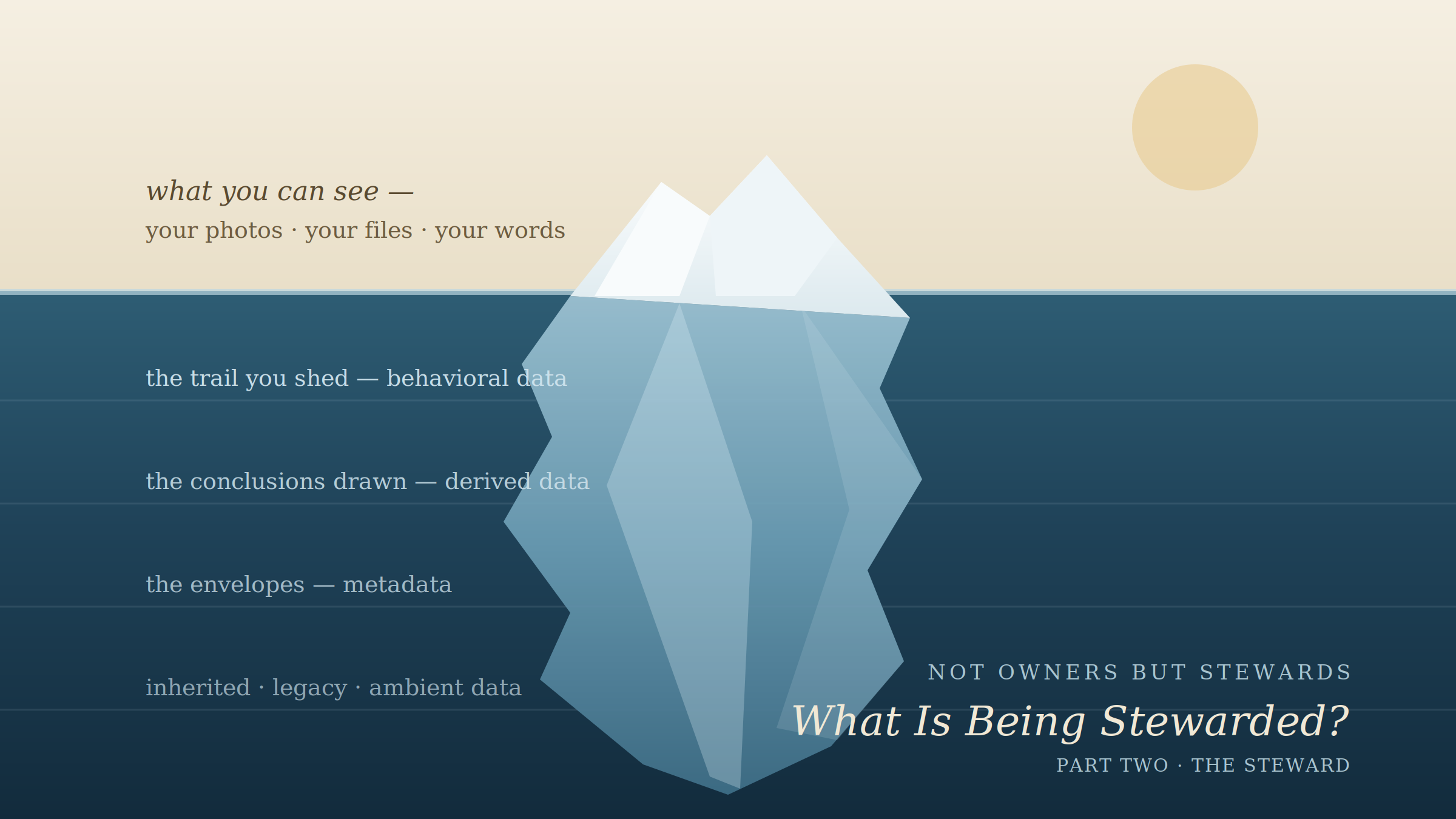
Most people, if asked, would point to their files. The photos on their phone. The documents in a cloud folder. The emails in their inbox. Those are certainly data, and they matter. But they are only the visible part of something much larger — the part above the waterline. To be a faithful steward, you first have to see the whole of what has been placed in your care. So let’s take an inventory.
The data you create on purpose
Start with the obvious layer: the data you consciously and deliberately make. Your photographs. Your letters and emails. Your journal entries, your tax returns, your recipes, the video of your daughter’s first steps. Your words, written and spoken.
This is the data most people already feel some instinct to protect, because it is plainly theirs in the everyday sense. You made it. You can point to it. If your house caught fire, this is the data you would grieve.
Notice something, though: even this most personal layer is rarely about you alone. That photograph contains your daughter’s face. That email thread contains your friend’s confession about his marriage. That contact list holds the phone numbers, addresses, and birthdays of a hundred people who never agreed to be in your files. From the very first layer, stewardship is already about more than self-interest. Other people live in your data.
The data you shed without noticing
Beneath the deliberate layer sits something most people never inventory: behavioral data. This is the record not of what you said, but of what you did.
Every search you type is a question you asked out loud to a company. Every purchase is a vote recorded. The route you drove this morning, the time you woke up, how long you paused on a particular photo, which articles you read to the end and which you abandoned after a paragraph — all of it is captured, timestamped, and stored, mostly by parties you have never met.
You did not sit down and author this data the way you author a letter. You shed it, the way you shed footprints crossing wet sand. But it is data about you all the same — and in many ways it is more revealing than anything you would write deliberately, precisely because you never composed it for an audience.
The data made about you
Then there is a stranger layer still: derived data. This is information that no human being ever typed anywhere — conclusions calculated about you from everything above.
A credit score is derived data. So is the advertising profile that has decided you are a 45-to-54-year-old male, likely a homeowner, likely religious, likely in the market for a truck. So are the health predictions an insurer’s model might draw from your grocery purchases, and the “people you may know” suggestions built from patterns in your contacts.
You never created this data. You may never see it. Yet decisions about your loan, your insurance premium, and what information reaches your eyes are made from it every day. Part of stewarding your data is understanding that this layer exists — and that it is manufactured downstream from the layers you can influence.
Metadata: the envelope, not the letter
There is an old distinction in law between the contents of a letter and the outside of the envelope. The contents are private; the envelope — who wrote to whom, when, from where — was always considered less sensitive.
That distinction has collapsed. In the digital world, the envelopes alone tell nearly the whole story. Metadata — who you called, when, for how long, from what location, how often — can reveal a medical diagnosis, a job search, a failing marriage, or a crisis of faith without a single word of content ever being read. A call log showing your number connecting to an oncologist, then a second oncologist, then a support hotline needs no transcript.
The faithful steward learns to see envelopes as letters.
Inherited data and the data you will leave behind
Data also moves across generations, in both directions. You may already hold inherited data: your late father’s email account, the scanned letters of a grandmother, the family photo archive that landed on your hard drive because you were the responsible one. That data was entrusted to you in the most literal sense of the word — someone died, and it passed into your hands.
And one day, everything in this inventory becomes someone else’s problem or someone else’s treasure. Your accounts, your archives, your passwords, the forty thousand photos nobody has sorted. What you leave behind, and whether anyone can access it, is a stewardship question you are answering right now by default, whether or not you have ever thought about it.
Ambient data: the machines that watch the house
Finally, the newest layer: data generated not by any person at all, but by machines observing the world. The doorbell camera recording every neighbor who walks past. The smart speaker’s microphone. The thermostat logging when the house is occupied. The car reporting its location to the manufacturer.
Ambient data is different in kind from a letter or a photograph. Nobody sat down to make it. It simply accumulates, continuously, like dust — except that this dust is a permanent, searchable record of daily life, often stored on servers you do not control, capturing people who never consented to appear in it.
The full inventory
Put the layers together and the picture changes. “My data” is not a folder of files. It is:
the words and images you deliberately create; the behavioral trail you shed; the conclusions others derive about you; the metadata envelopes around everything; the archives entrusted to you by the dead; the estate you will leave to the living; and the ambient record your own devices generate about your household and your neighbors.
That is what is being stewarded. Not a possession, but a sprawling, living estate — much of it containing other people, much of it generated without your intent, all of it consequential.
An owner could look at that inventory and shrug. An owner has the right to be careless with what is his. But we opened this series by rejecting that frame. If this estate has been entrusted rather than merely possessed, then seeing its full extent is not a curiosity — it is the first duty of the job.
Which brings us to the question the next article must answer: now that we see what has been placed in our hands, why does it matter? What is actually at stake when stewardship fails?
That is Part 3.
Not Owners But Stewards is an ongoing series from The Steward exploring what faithful data stewardship requires. Part 1: What Is Stewardship? Part 3: Why Does It Matter? — coming soon.